Tactics
Drop Shotting for Bass: A Finesse Rig Worth Learning
September 1, 2026 •iSportsman Staff
May 28, 2026
Doug Howlett
As any turkey hunter knows, most hunts seldom go as planned. Heck, a lot of seasons seldom go as planned. And with the final states with an open turkey season down to their final few days, the lucky hunters still in the woods need to make trigger time happen and make the most on a last-chance gobbler.
If you’re faced with this situation, it’s time to go beyond traditional tactics. If you’re a diehard traditionalist who is only interested in sitting down and calling one up, then these tactics may not be for you. They require a hunter to move (sometimes a lot) and to work with whatever surroundings are available to get in position and remain concealed. Here’s how to pull it off.
On a hunt for California Merriam’s some years back at the famed Tejon Ranch just north of Los Angeles, I found myself paired up with my good friend Jonathan Harling. Harling and I used to work together at the National Wild Turkey Federation and looking at the weather for the week, we both realized one thing: Whoever didn’t kill a bird the first day of the hunt, probably wasn’t going to get one. A brutal front of uncharacteristic Southern Cal wind and rain was slated to move in and wreck the last two days of what was just a three-day hunt so we knew we had to make it happen on what would be that first bluebird day. That meant locating gobbling birds and getting on them fast.
Fortunately, our guide, Steve Ryan, knew a large draw where one roosted and walked up every morning after flydown. We slipped in under the cover of darkness, set up on the gobbling bird, and of course, this one morning, it didn’t come up the draw. Instead, it made the steep climb up an adjacent mountainside. It was time to go after the bird. The trick to hunting turkeys in mountainous or hilly terrain is to never let them get above you. It’s rare that you’ll ever call a bird down a hill to you without him spotting you first.
So, we did a big looping climb up the hill in order to give us time to at least get level with him. We managed to keep the bird located by calling to it on the move and getting it to gobble back before it finally hung up on a bluff directly across from us. We poured the calling on for a few minutes getting him fired up and then shut up completely. At least 25 to 30 minutes passed without a sound from us or the gobbler, and just as we thought our strategy of trying to make him think the hens had left and he better come looking, a gobble boomed from less than 60 yards away. The tom was looking for us. As he slipped into range, Harling took the bird down with a face full of Winchester Xtended Range No. 5s. This same trick can work when you only have a day or two left in the season.
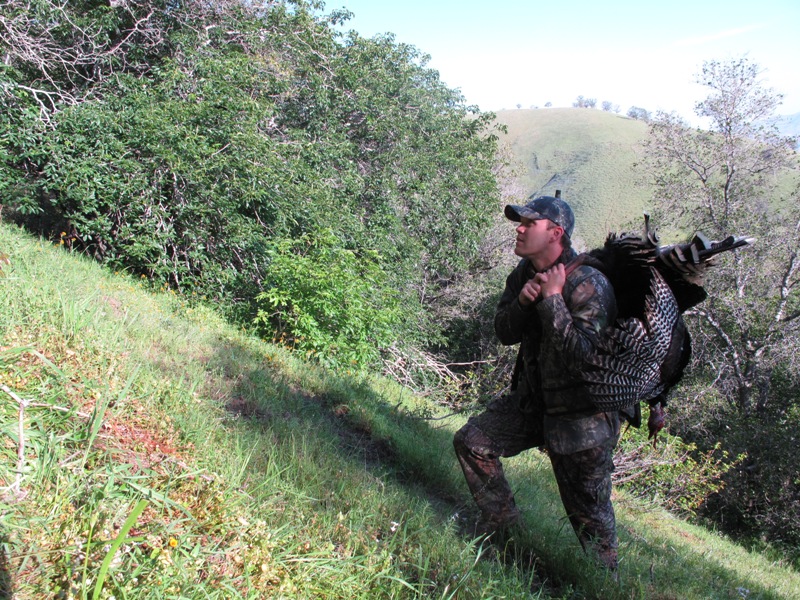
A hunter scores on a tom when he has to make something happen. Doug Howlett Photo
That afternoon, we got on another group of what sounded like three gobblers and a handful of hens working through a creek drainage. The toms were courteous enough to gobble at our calls from time to time, but no way were they going to leave the girls they already had in sight. The best we could hope for was to stick with them until we could pull a gobbler lose from the group.
We did that for what approached two hours, lost them briefly, got back on them after one of the birds gobbled and wound up in a stalemate with them on one side of a small hill and us on the other. California’s 4 p.m. legal end to spring turkey shooting hours at the time was fast approaching—like within 30 minutes. We could wait no longer.
Leaving Harling at the tree to call from time to time, Ryan and I slipped up the hillside to try and get an eye on the birds. We spotted a gobbler about 70 yards below us and decided to start soft yelping, purring and scratching in the leaves. We had closed more than 100 yards of distance between us and the turkeys. The hillside was open with little brush, so all we could do is keep low below the rise and be ready. When the longbeard poked his head over it to take a look. I shot. Five minutes later and we would have had to call it a day. Oh, and when the weather rolled in, nobody else on that hunt killed a bird. Our hunch had been correct.
It seems more and more these days, henned up gobblers isn’t just an early season situation, especially when the spring is cooler than usual like this spring was in the East. I set up on a lone gobbling bird on the last day of Virginia’s turkey season the other week, feeling pretty good about my odds. I was right at a 100 yards away from him and figured I’d be the only hen to sound off when he was ready to fly down. I was wrong. I was incredibly wrong!
As the sky began to brighten and the tom gobbled more, a hen sounded off with soft tree yelps out in front of me. Then I heard another angled off to the right behind her and then a little while later, another yelped directly to my right. And yes, as if trying to sink my hopes completely before the gobbler even flew down, another yelped to my left and another from behind me. I was surrounded. I heard the gobbler finally pitch down—across the creek from where I sat onto an adjoining property—and soon after all the hens followed. Because I had no other options going. He was the only bird I heard that morning. I tried calling him every which way I could hoping to somehow coax the flock my way and back on my side of the water. (I knew it was a less than 1 percent chance, but crazier things have happened.) Of course, it didn’t happen that morning, and the birds finally wandered away into total silence.
Henned up birds at any time of the season can be tricky. Yelp and cutt and the jealous hens may lead big boy in the other direction as they continued to do across the creek from me. Assuming all of the turkeys are on your side of a creek or swamp, and maybe hanging out in the open, a gobbler decoy or fan if legal and in a place you can use it safely can fire up the temper of a dominant tom and bring him running, or it can completely fill him with uncertainty at the sight of this new challenger and send him away as well. One thing these flocks do tend to do is, if not hassled by people or predators, they roost in the same spots and head the same way off the roost every morning. Scout these turkeys out and set up along their usual travel route.
Some years back on the same land my season ended on this year, I had scouted out a flock of 30-plus birds a week before the opener. That huge flock included seven strutters. Watching four of those gobblers and some hens enter a field in the same spot on opening morning but not getting them to come to my calls, the next time I went in I got there under the cover of darkness and set up in the spot I had seen them enter the field every time. I only had an hour to hunt before blowing out for my kid’s soccer game, so I didn’t make a peep or do anything to betray my presence. When the birds flew down, true to form, they walked by and I shot—a nice longbeard less than 30 steps away.
In the final days of a season, less calling can be more. Go back to scouting a bird out from a distance, listen and watch, if possible, for field birds, learn his habits, and leave him alone until you are ready to slip in and close the deal.
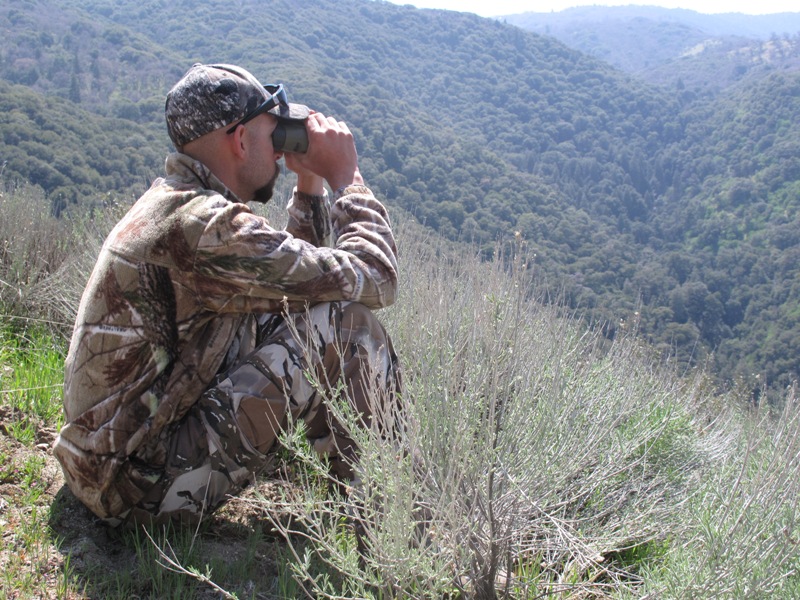
Backing off the hunting pressure and glassing open areas to learn a bird’s pattern can help you win the game the next day. Doug Howlett Photo
Turkeys are creatures of keen instincts, but perhaps not as much intellect as humans would like to give them. When the success of full gobbler decoys decades ago gave way to success by just using fans or fans mounted on ¼-strut jake decoys, and concerns about safety, sometimes wrongly, gave way to social media trends, simply using the fan of a strutter to “fan” or “reap,” whatever you prefer to call it, rose in popularity. For safety’s sake I cannot stress enough that you can only try this on private land and in places where you are certain no other hunters are around and where you have a good view of the surrounding area should somebody approach. Hunters have been killed fanning, and this should only be used in wide open country where it is clear, a hunter is holding the fan to another hunter. That said, the still controversial tactic is a deadly one for sure for toms. Faced with a bird hanging up out of range or sticking to the middle of a field, you can slip in to where the tom will be able to see you upon rounding a bend or coming over a slight rise and open and spin a turkey fan as if it is actually on the derriere of a live tom. This is often enough to convince the real gobbler that he is looking at a true challenger and bring him running right in.
Hunting the open terrain of the Midwest and West, the truth is, a lot of gobblers will just hang out in the wide open without a bit of cover for several hundred yards. There they will strut and gobble but never move closer to your calls preferring instead to wait for the hen they think you are to come to them. In those cases, you need to figure out a way to do just that.
Using hillsides, ditches, scattered piles of brush or small saplings, even slight humps in the ground that will afford enough cover to belly crawl behind, use these to close as much distance as possible between you and the turkey. I’ve used this trick to close what was several hundred yards between me and a bird to less than a hundred and in so doing, you often put yourself inside that gobbler’s comfort zone and can bring him the rest of the way with some soft calling. Many of these shots may be taken from the prone position or without the benefit of a wide tree to sit against, so practice those shots before you attempt them.
The clock is ticking. Don’t waste any time and fill that final tag…that is if you are lucky enough to live or hunt where the season is still open.