Tactics
Spinnerbaits for Bass
January 30, 2026 •John N. Felsher
December 8, 2025
Brad Fenson
Places like Saskatchewan and Kansas have long been known for producing big whitetails, and last season I was reminded just how easy it is to misjudge one of those legendary bucks in the moment. I was hunting with my good friend when we spotted a heavy, tall-antlered deer that instantly stopped me in my tracks. At first glance, I knew he was something special. Unfortunately, I hesitated. I let my mind get tangled up in antler math, second-guessed what I was seeing, and watched that buck trot away into the hills. Months later, I still replay the encounter and know without question that I should have taken the shot.
That moment taught me a valuable lesson about judging deer in the field. Antlers can trick the eye, and in the excitement of a hunt, it’s easy to overestimate or underestimate what you’re looking at. Ground shrinkage, where a buck looks smaller after it’s down, happens to every hunter at some point. The best way to avoid mistakes is to understand how antlers are scored and what characteristics contribute to size and symmetry.
The Boone and Crockett scoring system is the benchmark for most hunters and is the same method used by Pope and Young for archery and Longhunter for muzzleloader records. The minimum score for a typical whitetail to make the all-time Boone and Crockett book is 170 net inches. When you hear someone talk about a 160- or 190-class deer, they’re referring to this scoring method.

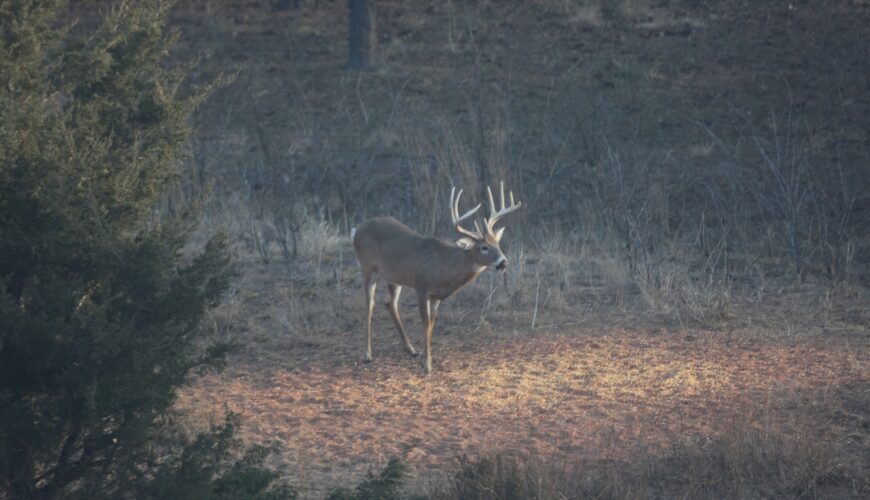
Learning what adds up to a high-scoring buck takes practice, but when he’s big…he’s big. Brad Fenson Photo
Learning what adds up to a high-scoring buck takes practice. Antlers are judged on four main features: tine length, beam length, inside spread, and mass. All of these contribute to a deer’s total score, but each has its own influence. Tine length adds inches fast. Long, evenly spaced points that stretch ten inches or more make a rack stand out immediately. A mature record-book buck will usually have at least four points per side, not counting the main beam. Beam length is often overlooked, yet it can account for nearly a third of the total score. Long sweeping beams that reach out past the deer’s nose or curve inward add valuable inches.
To visualize beam and tine length in the field, compare them to the buck’s features. The average whitetail ear measures about six and a half to seven inches long. The head of a mature buck runs around fourteen inches from nose to back of skull. If the main beam reaches past the nose, you’re looking at a deer with exceptional length. The spread between the ears on a relaxed buck averages about eighteen inches, so any antlers that extend well outside that mark are a good sign.
Mass can be harder to judge, but it’s what gives a rack that heavy, powerful look. Thick beams that resemble the width of a man’s wrist usually mean the deer carries strong circumference measurements. Northern whitetails often have more mass than deer from southern regions, which is one reason so many hunters dream of heading north each fall.
Symmetry also plays a role in the final score. Boone and Crockett deduct any differences between the left and right antlers from the total gross score to create a final net score. A buck that is nearly identical on both sides will score higher than one with uneven points or mismatched tine lengths. That said, some of the most impressive deer you’ll ever see might not be the highest-scoring ones on paper. Non-typical points, unique character, and long sweeping beams can make a buck unforgettable even if he doesn’t make the record book.
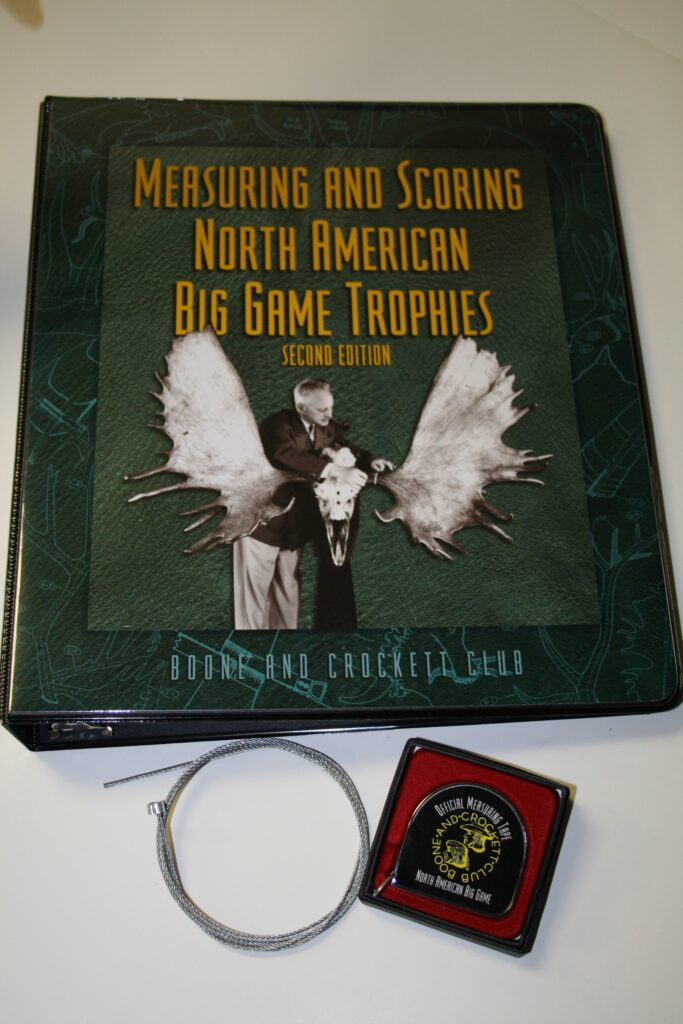
The Boone and Crockett scoring system is the benchmark all other scoring methods are based off. Brad Fenson Photo
When field judging, start by taking a quick point count, noting how many tines each antler carries beyond the brow tine. Estimate tine length by comparing to the ear, beam length by comparing to the nose, and spread by comparing to the ears. Then look for overall balance and mass. With time and repetition, you’ll get faster and more accurate at reading a rack in seconds.
The giant four-point I passed on in Saskatchewan would have scored somewhere in the mid-160s, easily one of the best whitetails I’ve ever seen. I did fill my tag later a heavy, mature buck that scored in the mid-140s, but the one that got away taught me more than the one I shot. Field judging whitetails isn’t about chasing numbers; it’s about understanding what you’re looking at and appreciating the deer for what it is.
Every hunter wants a big buck, but sometimes the best memories come from the ones that slip away. The next time I’m back in the deer woods anywhere, I’ll be ready. I’ll trust my instincts, use what I’ve learned, and know exactly what I’m looking at before I ever touch the trigger.
Want to Score Your Buck Once He’s on the Ground? Check out the online scoring calculator from Boone & Crockett.
January 9, 2026 •Guest Contributor
December 17, 2025 •iSportsman Staff