Tactics
The Importance of Patterning Your Turkey Gun
March 18, 2026 •Doug Howlett
March 30, 2026
Doug Howlett
Deer hunters have been groomed their entire hunting lives to aim for the heart and lung vitals of the large-bodied animals. That may make shot placement on a wild turkey feel counterintuitive. Why? Because with a wild turkey, head and neck shots are the preferred way to go with a shotgun. A body shot on a heavily feathered, fat-chested gobbler at distance can lead to a bird that, though maybe crippled, can still get away. Proper shot placement is absolutely critical—perhaps more so than mastering your calling technique—to reliably punch your turkey tags each spring.
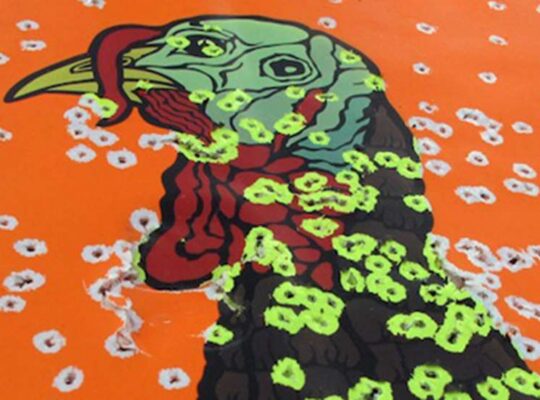
The quickest, surest way to drop a gobbler in its tracks is to deliver a tightly patterned load of No. 4, 5 or 6 shot (or higher with heavier-than-lead loads) right into the exposed head and neck area.
Why not the body? There are several reasons you want to avoid shooting a turkey in the body, the first being the fact that virtually all hunters are using fairly small-sized shot. Despite its penetrating abilities, the shot must pass through a gobbler’s thick cover of feathers, as well as its muscled chest, to strike a smallish heart and other vital organs. Unless a turkey is less than 20 yards away, much of the shot will not fully penetrate or find the organs it must to bring on a quick, clean kill. It’s just as well since the breasts, which the shot must pass through, also provide the primary meat a hunter will eat, and nobody wants to eat meat riddled with tooth-breaking shot.
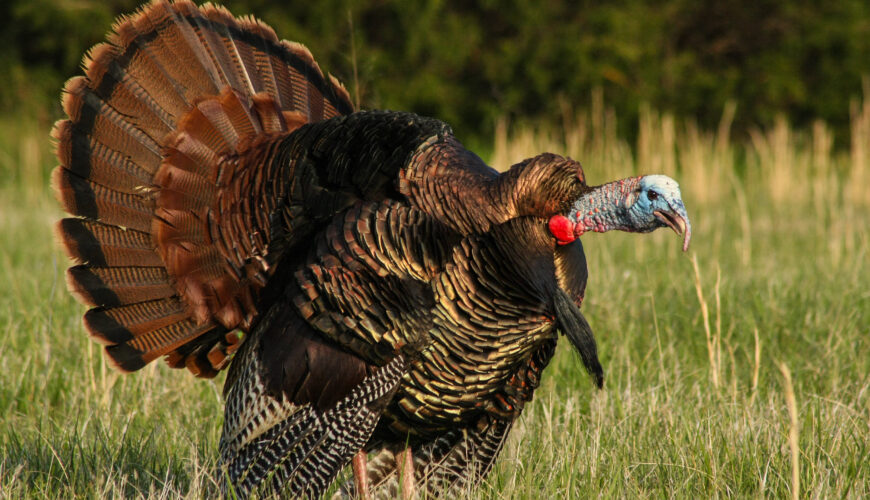
When a turkey is in full strut, its feathers also make the body look much bigger than it really is, and a poorly aimed shot that looks like it is heading for the center of mass could cause the hunter to miss vitals. The head, on the other hand, is small but exposed, and contains the brain, while the neck, also exposed except when the bird is in full strut, contains the nerves and blood vessels that circulate both senses and blood to the spine and the rest of the organs. A bone-crushing shot to the head and neck immediately disrupts this flow and, except for the shattered avian reflexes of a dying bird, leaves the wild turkey feeling no pain and expiring in an instant.
But don’t just aim at the turkey’s head. If your point of aim is slightly high, you could miss the bird entirely. Instead, aim right above the line of feathers that join the fleshy part of gobbler’s neck. This allows the spread of shot to cover the entire area where the head and neck will be, while allowing some margin of error for a slightly misaimed shotgun, depending on how close the turkey is.
When it comes time to take the shot, the turkey’s head and neck should be exposed from being extended. Try to avoid shooting a gobbler in full-strut, particularly when the tom is broadside to your position. In strut, the tom pulls its head and neck down tight against its puffed out chest, which provides more protection and can block much of the shot intended for the target area. I’ve seen hunters attempt shots at birds still in full-strut from the side, typically with two results.
If the bird is close enough, it will often collapse with an explosion of feathers as if a pillow has just been shot, because most of the shot strikes the body, riddling the facing breast with shot. In other instances, if the point of aim pulls ahead of the bird from a slapped trigger or torqued firearm, the turkey will scramble to its feet, even when hit, and require a follow-up shot. Those shots are often panicked shots that turn into a chase where the bird can often escape. Even if bloodied, finding a wounded turkey is near impossible, as the feathers soak up much, if not all, of the blood, leaving no trail to follow. In some cases, wounded turkeys can still take flight too, which adds to the likelihood of never finding the bird. A straight-on shot at a bird in strut can kill it, but almost always results in a shot off beard and peppered turkey breasts.
To pull a bird out of strut, cutt or cluck on your mouth call until the strutter stops and lifts his head up to see exactly what made the noise. Be ready to shoot as soon as the turkey lifts its head, because it is typically about to pinpoint you and get out of the area. I’ve seen guys yell something to the bird like “hey” or “get up” or things like that, but I’m not a big fan of doing that unless absolutely necessary. When you do that, the turkey is coming out of strut already alarmed and ready to bolt, which ultimately makes for more rushed—and missed—shots by hunters.
The range that produces the ideal spread from a modern high-performance turkey load and extra-full choke combination is between 20 and 40 yards. In that ballpark range, regardless of what you are shooting, shot density and energy are at their combined best. Based on recommendations from the Wild Turkey Task Force assembled by the National Wild Turkey Federation many years back, 40 yards has long been the suggested maximum distance for shooting at a wild turkey. This is admittedly still a good guideline, even with the much more powerful heavier-than-lead loads available to hunters, as it provides for some error on misjudging the distance between hunter and gobbler, particularly in open fields where everything looks closer.
For the practiced, however, many of these modern loads are admittedly capable of reliably taking birds out to 50 and even 60 yards, though patterns are spreading and shot dropping even at that distance. Beyond that, it becomes a crap shoot, and every hunter owes it to the species to make sure that they take the most reliable, ethical shot they can. Spring turkey hunting for most of us has always been about getting a bird in close anyway. So, stick with that.
As for close shots of 15 yards or less, these typically result in more misses than birds at the edge of a hunter’s maximum shooting range simply because the pattern has yet to open up. It’s more like shooting a single-projectile slug at a turkey than a cloud of shot, which is why I’m a fan of open, rifle-type sights on today’s turkey guns. Up close, precise aim becomes that much more critical.
January 9, 2026 •Guest Contributor