Gear
Vortex Talon HD 10K Ballistic Laser Rangefinding Binoculars
March 4, 2026 •Zenna Howlett
December 5, 2025
Brent Spicer
Anyone who’s spent significant time hunting in the southeastern states knows the feeling—that unmistakable sensation of being watched from the brush. Whether it’s the distinctive grunt of feral hogs moving through palmetto thickets in Georgia, the silent padding of a bobcat stalking your turkey calls in Alabama, or the increasingly common sight of black bears in the Carolinas and Tennessee, predator encounters are becoming a reality for many southeastern hunters.
After hunting the southeastern states most of my life, I’ve developed a healthy respect for our region’s predator population. While rarely aggressive without provocation, these animals can become dangerous when surprised, cornered, or protecting young. The surging feral hog population presents perhaps the most persistent threat, with documented attacks increasing yearly as these invasive animals expand their territory and grow increasingly habituated to human presence.
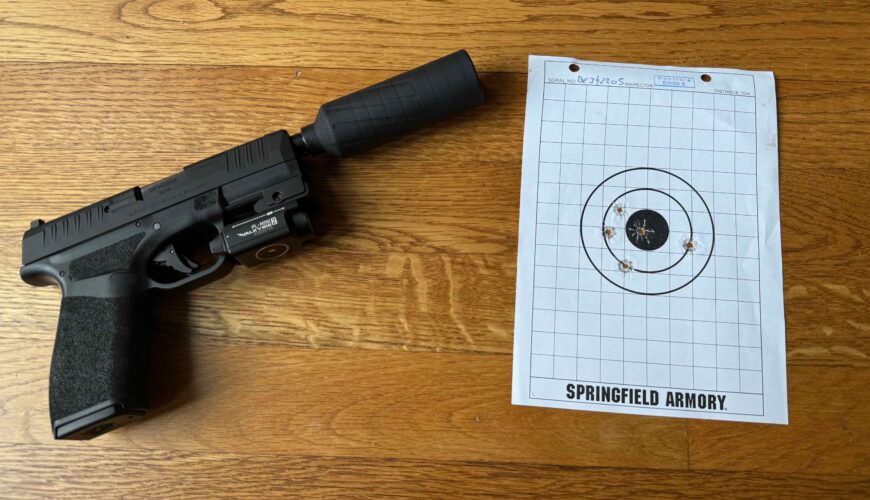
My search for the ideal defensive system for southeastern hunts led me to an unexpected combination: the Springfield Hellcat Pro OSP with threaded barrel paired with Silencer Central’s ultra-lightweight BANISH 9K suppressor. After years of hunting and dozens of real predator encounters across the Southeast, this setup checks all the boxes of my needs.
The conventional wisdom about backcountry defense usually involves large-caliber revolvers. However, the southeastern hunting context presents unique considerations that favor a different approach. Dense vegetation limits typical engagement distances to under 25 yards—often much closer. Multiple-animal threats (particularly with hog sounders) make capacity a critical factor. And the proximity of hunting properties to populated areas makes sound management increasingly important.
The Springfield Hellcat Pro OSP addresses these requirements with its 15+1 capacity, manageable size for all-day carry, and reliability that remains unfazed by the Southeast’s notorious humidity and dust. The factory-threaded barrel option means no gunsmithing modifications and consistent performance with the attached suppressor. For hunters moving through thick palmetto scrub or navigating swampy terrain, the compact dimensions make a noticeable difference during all-day carry. You also have the option of adding an optic if that’s your preference and use the night sight as a backup.
The Hellcat Pro is a solid carry option by itself but adding the BANISH 9K suppressor transforms this platform in ways particularly relevant to southeastern hunters. At just 4.1 inches long and an almost unbelievable 2.7 ounces (yes, ounces), the 3D-printed titanium suppressor adds minimal bulk while providing significant advantages. Beyond preserving hearing during defensive situations where multiple shots may be required, the suppressor prevents your location from being broadcast across the entire property after a shot—crucial when predator defense is followed by resumed hunting.
Most importantly for mobile hunters, the BANISH 9K doesn’t require a Nielsen device (booster) to function reliably on the Hellcat Pro. This engineering achievement eliminates a potential failure point while simplifying field maintenance, both critical considerations when miles deep in a palmetto flat or hardwood bottom with no cell service.
My evaluation focused on scenarios specific to southeastern hunting applications. Rather than sterile range testing, I carried this combination throughout multiple hunting trips across varied habitats—from hardwood ridges to crop field creek bottoms to pine plantations.
The combination underwent extensive testing in the region’s challenging climate conditions. During early-season deer hunts with temperatures in the low 90s and humidity to match, many firearms and suppressors develop functioning issues as lubricants thin and parts expand. The Hellcat Pro/ BANISH 9K pairing showed no such vulnerabilities. Cold weather hunts in December didn’t phase the pistol either. Even during torrential thunderstorms (an almost weekly occurrence during spring turkey season), the combination maintained perfect reliability.
Carry method proved critical for southeastern applications. Traditional belt holsters position the suppressor awkwardly against the hip, creating snag points in dense vegetation. After testing multiple options, I settled on a shoulder holster. This keeps the system accessible even when seated in a blind or wearing waders, while the vertical orientation prevents the suppressor from catching on brush during movement.
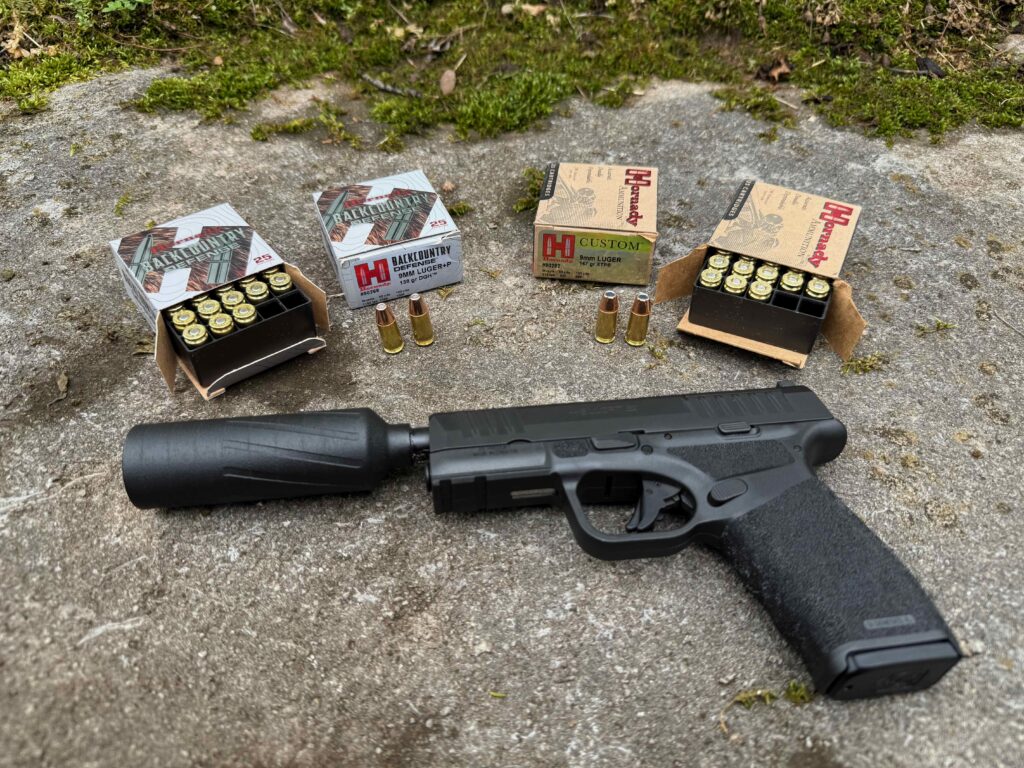
Ammunition selection for southeastern predator defense presents unique challenges. Brent Spicer Photo
Ammunition selection for southeastern predator defense presents unique challenges. The region’s most common threats—feral hogs, black bears, coyotes, and bobcats—vary significantly in size and physical characteristics. After extensive testing, I focused on two loads that provide optimal performance across this threat spectrum: Hornady Custom 147-grain XTP and their purpose-built 138-grain Backcountry Defense ammunition.
The Hornady Custom 147-grain XTP quickly established itself as an outstanding all-around option for this application. At typical southeastern predator engagement distances (under 25 yards), this ammunition consistently produced sub-2-inch five-shot groups from the Hellcat Pro. When fired through the Banish 9k, velocities averaged 975 fps—comfortably subsonic for optimal suppressor performance while maintaining sufficient energy for medium-sized predators like coyotes and bobcats.
During a controlled test simulation using ballistic gelatin with heavy hide and bone simulants, the XTP projectiles penetrated to depths of 14-16 inches while expanding reliably to approximately 0.54 inches. This performance envelope matches perfectly with the anatomical requirements for stopping smaller to medium-sized predators common in many southeastern hunting areas.
For larger threats like mature boars and black bears, Hornady’s specialized Backcountry Defense ammunition proved exceptional. These +P 138-grain loads feature monolithic copper projectiles specifically designed for animal defense scenarios, with controlled expansion and deep, straight-line penetration characteristics. In standardized testing, these projectiles consistently achieved penetration depths of 18+ inches while creating substantial wound channels—critical for quickly stopping larger predators with thick hides and dense muscle structures.
The sound reduction with both loads when fired through the BANISH 9K proved impressive. The subsonic 147-grain XTP registered approximately 132 decibels at the shooter’s ear, while the faster supersonic Backcountry Defense loads measured around 135 decibels. Both remain below the threshold for hearing damage—a critical consideration when firing inside a ground blind or firing multiple rounds typical of southeastern predator encounters.
The region’s unique hunting environments create specific requirements for defensive carry systems. Dense vegetation, extreme humidity, frequent water crossings, and often punishing heat shape every equipment choice.
For southeastern applications, the shoulder holster proved unquestionably superior to belt-mounted options. Beyond preventing the suppressor from snagging on vegetation, this configuration distributes weight more comfortably during all-day use in high temperatures. It also keeps the pistol accessible when seated in blinds, climbing into stands, or navigating water crossings—all common scenarios in southeastern hunting.
Ammunition storage requires special consideration in the region’s hostile climate. I recommend carrying defensive rounds in a sealed, waterproof container. This prevents contamination during the inevitable water crossings and downpours while ensuring your defensive loads remain pristine. Rotating these rounds every few months prevents degradation from the region’s extreme humidity.
The Hellcat Pro’s standard capacity of 15+1 rounds addresses another southeastern-specific concern: multiple animal threats. Unlike western bear encounters that typically involve single animals, southeastern hunters frequently face hog sounders numbering a dozen or more individuals. Having sufficient capacity to address multiple threats without reloading can be critical when dealing with a group of agitated hogs.
Maintenance in the field became a significant consideration. The Hellcat Pro’s simple design allows basic cleaning without tools, while the BANISH 9K’s sealed construction prevents internal fouling during typical defensive use. I recommend carrying a simple field maintenance kit including a bore snake, lightweight lubricant, and spare thread protector. After water crossings or heavy rain, a quick wipe-down and application of fresh lubricant keeps the system ready for immediate use.
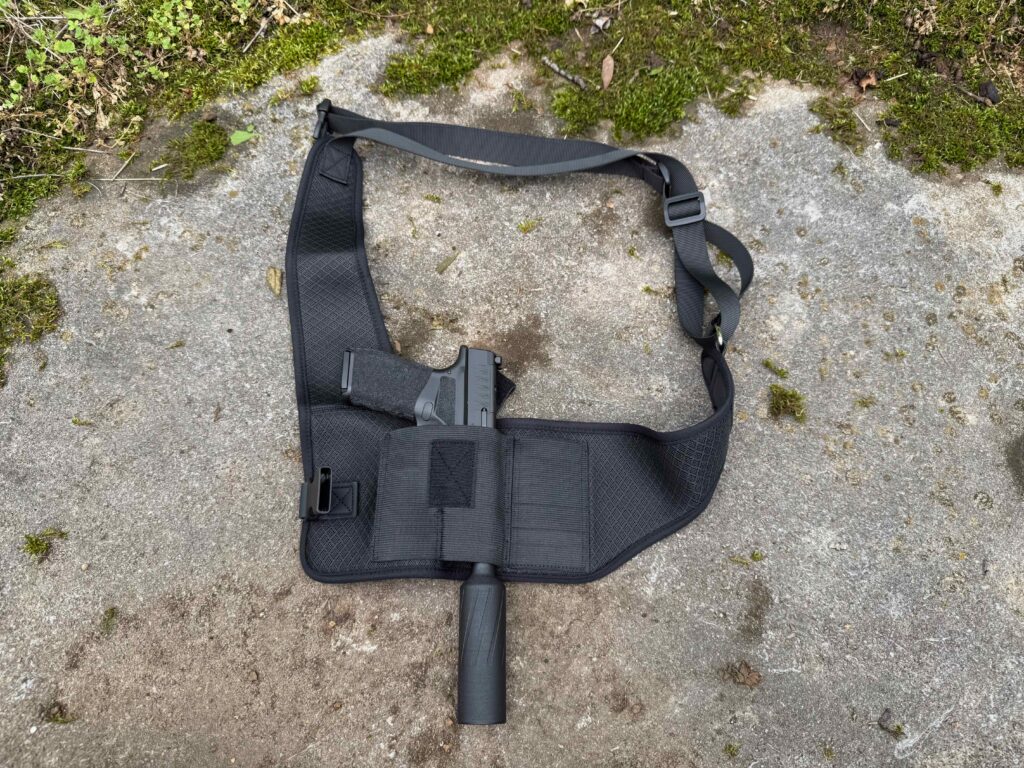
Given the Southeast’s thick vegetation, the shoulder holster proved unquestionably superior to belt-mounted options with the suppressed handgun. Brent Spicer Photo
After field testing across multiple hunting trips and several predator encounters, the Springfield Hellcat Pro OSP with threaded barrel paired with the BANISH 9K suppressor has proven an ideal defensive combination for southeastern hunting applications. The system offers an optimized balance of capacity, portability, and effectiveness against the region’s most common predator threats. I’ve used it as a backup when rifle hunting as well as additional protection while bowhunting.
When loaded with purpose-designed ammunition like Hornady’s Backcountry Defense, this combination creates a highly capable defensive system that remains comfortable to carry through long days in challenging terrain and punishing climate conditions. The reduced sound signature provides significant advantages in managed hunting situations, preventing defensive shots from disrupting an entire property.
For guides responsible for client safety or solo hunters in remote areas, this combination addresses the unique requirements of southeastern predator defense while remaining unobtrusive enough for all-day carry. While proper wildlife awareness and avoidance techniques remain the first line of defense, having a reliable, purpose-built system like this provides valuable insurance when those techniques prove insufficient.
February 25, 2026 •iSportsman Staff