Places
Turkey Season 2026: GAME ON!
March 13, 2026 •Doug Howlett
February 2, 2026
John N. Felsher
Constructed to mark channels, direct currents or otherwise control the forces of nature, jetties create outstanding structures that attract various fish species, particularly in the gulf.
“Jetties are good places to fish because they provide food, protection and habitat for fish,” explained Marie Head, an Alabama Marine Resources Division biologist. “Around Gulf Coast jetties, anglers typically catch sheepshead, redfish, gray or mangrove snapper, pompano, sharks, black drum, flounder, whiting and southern kingfish.”
At jetties, anglers can catch huge, powerful fish without venturing miles offshore, sometimes, even without a boat. Redfish and large black drum cruise the rocks looking for crabs, baitfish, shrimp and other morsels.
For bull reds, use live or cut mullets, menhaden, also called pogies, or croakers. Big reds and monster black drum love crabs. Hook a whole crab near its rear rounded swimmer fin. Crack the top shell so succulent juices ooze out. Crab halves also make outstanding baits.
Sheepshead always stay tight to barnacle-encrusted structures. Besides barnacles, sheepshead love shrimp and small crabs. Fish live shrimp, fiddler crabs or small blue crabs as close to structures as possible. Speckled trout tend to roam a bit farther off the rocks chasing pogies and shrimp.
“For big trout, I like throwing topwater baits,” commented Ronnie Daniels of Fisher-Man Guide Services (228-323-1115, msfisherman.com) of Pass Christian, Miss. “With larger profiles, topwaters tend to draw strikes from bigger fish. In my opinion, throwing topwaters is the most enjoyable way to fish. Even missing a fish is exciting!”
Practically all jetties supply good fishing opportunities at times, but a few along the Gulf Coast stand out.
Began in 1874, stacked granite jetties define the entrance to Galveston Bay. Among the longest jetties in the world, the south jetty extends 6.5 miles into the Gulf of Mexico. The north jetty stretches about five miles. In addition, anglers can fish a nearby structure that juts nearly five miles into Galveston Bay and other structures.
These structures hold sheepshead, redfish and black drum all year long. Anglers might catch flounder in the spring and fall. Sharks come around during the summer. The best speckled trout fishing occurs between March and Try fishing the North Jetty Boat Cut, a break that allows water to flow through the rocks and boaters to pass.
For Galveston information, see www.visitgalveston.com.
Forming part of the Louisiana-Texas border, Sabine Pass connects the gulf with Sabine Lake south of Port Arthur, Texas. The Sabine River flows into Sabine Lake, one of the top trophy trout and flounder spots on the Gulf Coast. Two granite structures extend about three miles into the gulf.
For big trout, drift along the rocks, tossing topwaters or jigs tipped with plastics. A popping cork dangling a live shrimp or baitfish makes a great temptation for many species.
In southwestern Louisiana, the 40-mile-long Calcasieu Ship Channel flows through the Calcasieu Estuary, connecting the Port of Lake Charles to the gulf. Along the way, it passes through Calcasieu Lake and several smaller lakes surrounded by marshes.
Two parallel rocky jetties mark Calcasieu Pass. The jetties extend slightly more than 1.5 miles into the gulf. Some of the oldest jetties in Louisiana, the west jetty dates to 1905. The east jetty dates to 1946.
“In May, we start to get a good trout run at the jetties with some big trout,” commented Kirk Stansel with Hackberry Rod and Gun (337-762-3391, www.hackberryrodandgun.com). There’s always redfish around the jetties. Everything must go between those rocks to enter or exit the estuary.”
To the east, people might also fish the mouth of the Mermentau River, also known as the Mud Lake Outlet. South of Grand Chenier, the jetties date to 1971 and run nearly 1.5 miles into the gulf.
For Southwest Louisiana information, see www.visitlakecharles.org.
The Mississippi River, the fourth largest river system in the world, drains an area of about 1.2 million square miles that includes all or parts of 31 states and two Canadian provinces across 40 percent of the continental United States. Over centuries, silt from those lands pushed the mouth of the river almost to the continental shelf. That incredible flow created and nourished some of the richest and most diverse wetlands in the world.
“The Mississippi River Delta is unique because of that great river,” advised Mike Frenette with Redfish Lodge of Louisiana (504-782-0924, Laredfish.com) in Venice Marina. “No other place in the country has anything like the incredible Mississippi River Delta. The river brings down so much nutrients for baitfish and other forage species that the fish grow big.”
Several jetties and other rock formations dot the delta. The most prominent mark South Pass and Southwest Pass. Besides speckled trout, redfish, drum and sheepshead, people fishing these jetties might also spot cobia, king mackerel, tripletail and other fish. During warmer months, people catch bluefish and Spanish mackerel. Sometimes, tarpon roll off the jetty ends.
The water drops to more than a thousand feet deep less than 10 miles from passes. The Mississippi Canyon elbows in toward the mouth of the river, creating fantastic offshore fishing. Offshore anglers frequently catch yellowfin and blackfin tuna, wahoo, and sometimes, blue marlin and sailfish.
For area information, see www.plaqueminesparishtourism.com.
The waters around Pass Christian offers good fishing around a variety of hard structures. The U.S. Highway 90 bridge and an old train trestle cross the entrance to Bay St. Louis. The bay spread across 27 square miles of estuary.
Mississippi established numerous artificial reefs all along the coast. Some sit in Bay St. Louis and Back Bay, also called Biloxi Bay, to the east. Many reefs consist of concrete salvaged from buildings, bridges and other structures demolished by various hurricanes, bringing life from disaster. Each inshore reef attracts a wide variety of fish species including redfish, flounder, speckled trout, white trout, whiting, black drum and other species. Most sit within easy range of public boat launches. Some sit close enough to the beaches that kayakers, or even waders, can fish them.
“Each reef is a fish oasis,” said Sonny Schindler of Shore Thing Fishing Charters (228-342-2206, www.shorethingcharters.com) in the town of Bay St. Louis. “The reefs get a lot of pressure, but they all hold fish. We’ve taken some big speckled trout, redfish and sheepshead off them. I wish the state would line the entire coast with artificial reefs because they are such good places to fish.”
For artificial reef locations, see www.dmr.ms.gov/marine-fisheries/artificial-reef. For Mississippi information, see www.coastalmississippi.com.
Perdido Pass connects Perdido Bay to the gulf at Orange Beach. The most prominent jetties in coastal Alabama, two concrete jetties measure about 1,800 feet. The east jetty largely sits on sand or in shallow water, good for pompano. Deeper water surrounds the west jetty, good for sheepshead, redfish and trout.
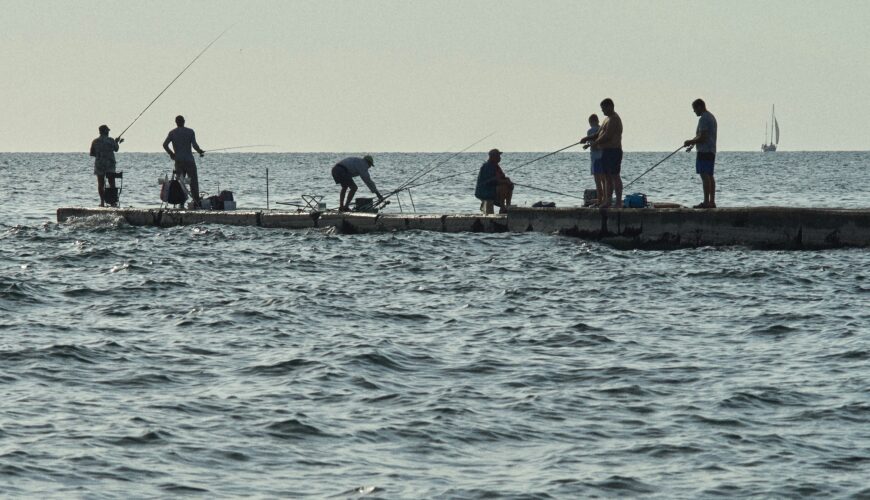
Many anglers without boats walk out onto the rocky structures to fish. Most use shrimp for bait. Some people fish live shrimp under popping corks for trout and redfish. The catch might also include bluefish and Spanish mackerel.
“Jetties are great places to catch fish,” emphasized Ritchie Russell with Russell’s Coastal Fishing (251-747-1896, www.russellscoastalfishing.com) in Orange Beach. “Jetties create an entire food chain around the rocks because they attract all kinds of things that are very tempting to big fish like sharks and redfish. What people see above the water is not the whole jetty. Jetties are really huge structures, but mostly underwater.”
People wanting big-game action without venturing too far offshore, try for sharks. Sharks traditionally start showing up in mid-April and stay through summer. People most commonly encounter Atlantic sharpnose sharks, which average about 2.5 to three feet long. Anglers might also tangle with spinner sharks or blacktips up to six feet long.
Anglers might catch great hammerheads. Great hammerheads can grow more than 14 feet long and weigh more than 1,200 pounds. Bull sharks regularly enter the bays and can even survive in fresh water. Stocky and powerful, bulls can top 11 feet long and weigh more than 600 pounds.
The kings of the coast, tiger sharks commonly cruise along the beaches and jetties. The second largest predatory shark in the world and a proven maneater, tigers can exceed 20 feet long and weigh more than 1,700 pounds. The Alabama state record weighed 1,019 pounds.
For area information, see www.gulfshores.com.
Although Destin hosts one of the largest offshore charter boat fleets in the United States, sportsmen can also find great action close to shore. Choctawhatchee Bay measures about 27 miles long by five miles wide and covers 129 square miles. The bay averages about 15 feet deep, but drops to more than 45 feet deep in places. The Choctawhatchee River flows into the system from the east.
The bay opens to the gulf primarily through Destin Pass, also called East Pass, an artificial channel created in 1929. Two parallel rock structures mark East Pass. The West Jetty extends farther into the water. People can also fish the U.S. Highway 98 bridge crossing the pass.
Anglers looking for bigger action need not run far. About five miles from the pass, natural bottom structures in about 60 to 90 feet of water hold good populations of red snapper and other reef fish. From March through May, cobia migrate from east to west along the northern gulf coast. Some come within a mile of shore in water less than 12 feet deep. Anglers looking for a good fight might throw topwaters at big jack crevalle terrorizing baitfish during the summer.
For Destin information, see destinflorida.com.
An incredibly rich ecosystem, St. Andrews Bay covers about 25,000 acres near Panama City. The system includes Grand Lagoon, West Bay, North Bay and East Bay. Jetties mark St. Andrews Pass where the bay connects to the gulf.
With little fresh water flowing into the bay except from a few creeks and springs, the estuary remains very salty and incredibly clear, creating excellent sight-fishing conditions. Salt marshes and extensive grass beds provide habitat for numerous species.
“The fishery here is very diverse,” said Jason Stacy of Shallow Water Expeditions Guide Service (850-534-4349, www.shallowwaterexpeditions.com). “We can fish the backcountry for redfish at dawn and the flats later in the morning. Then, we can fish along the beaches for cobia, mackerel, jacks, pompano and tarpon. Since the water is so salty, many gulf species come fairly close to shore. We’ve caught 60-pound cobia just off the beaches.”
For area information, see visitpanamacitybeach.com or destinationpanamacity.com.
Whether dropping a shrimp next to rocks for sheepshead, tossing live bait to cobia, tempting trout with topwaters or battling bull reds, anglers could spend a lifetime fishing for lunkers in these locations. No telling what might bite on any given day!
 John N. Felsher is a professional writer, broadcaster, photographer, editor and consultant. An avid sportsman, he’s written more than 4,000 articles for more than 176 different magazines on a wide variety of outdoors topics. He also hosts an outdoors tips show for WAVH FM Talk 106.5 radio station in Mobile, Ala. Contact him at j.felsher@hotmail.com or through Facebook.